You embrace the Joker’s ruthless clarity: one bad day can split your world and reveal the chaos beneath. You’ll feel how neglect, trauma, and a snapped identity can turn pain into dark humor and fierce, unsettling truth. This philosophy frames madness as both weapon and mirror, forcing you to question rules and sanity. If you want more lines that probe how a single moment reshapes persona and art, keep going and uncover the deeper echoes.
Joker One Bad Day Philosophy
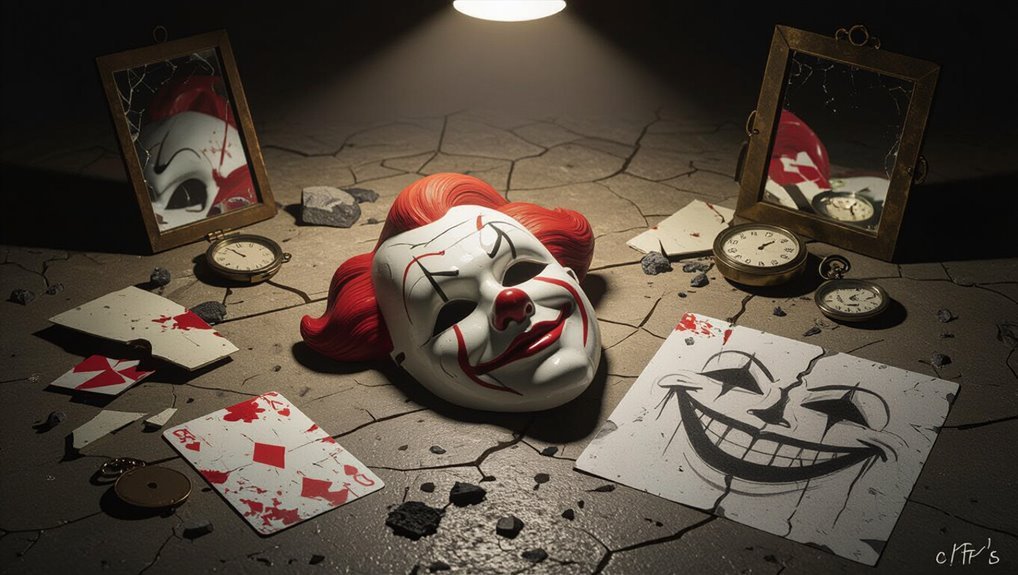
The concept of “one bad day,” as popularized by the Joker, serves as a provocative lens through which to examine human fragility and societal norms. It invites us to consider how quickly stability can crumble, pushing us to reflect on our own resilience and the tenuousness of our moral foundations.
- “A single moment can unravel the strongest of wills, revealing the chaos that lies beneath the surface.”
- “In the shadows of despair, we find the true measure of our humanity.”
- “Chaos isn’t the absence of order; it’s the unexpected twist that reveals our hidden fears.”
- “One bad day can fracture our reality, but it’s our choices that define the aftermath.”
- “When faced with darkness, remember: it’s the light within that holds the power to resist.”
- “Fear is a master puppeteer, but we hold the strings of our own destiny.”
- “Every breakdown is a chance to rebuild; every challenge, an opportunity to grow.”
- “Norms are fragile constructs, easily shattered by the weight of a single experience.”
- “To embrace unpredictability is to dance with the unknown; it’s both terrifying and liberating.”
- “Reflection in chaos reveals the strength we often overlook in ourselves.”
Understanding the Joker’s Perspective
Exploring the Joker’s perspective reveals a complex interplay between chaos and order, challenging our understanding of justice and societal norms. Through his lens, we face unsettling truths about the structures that govern our lives and the fragility of the human experience.
- “In a world built on fragile rules, the Joker dances to reveal the cracks we choose to ignore.”
- “Chaos isn’t absence but a compelling force that questions the fabric of our so-called civilization.”
- “To understand the Joker is to confront the uncomfortable truth that fear often masquerades as security.”
- “Order is merely a comforting illusion; the Joker strips it away to expose our deepest vulnerabilities.”
- “In laughter, he uncovers the absurdity of our existence, reminding us that sanity can be a cage.”
- “Marginalization breeds madness; the Joker is the voice of those society has silenced.”
- “Every act of chaos is a challenge to the status quo, forcing us to reevaluate who truly holds power.”
- “The Joker invites us to question: what happens when the oppressed finally break their silence?”
- “Behind every smile lies a story of despair; the Joker embodies the paradox of joy amidst chaos.”
- “In the theater of life, the Joker plays the role of the truth-teller, daring us to embrace the uncomfortable.”
The Impact of a Bad Day on Mental Health
Experiencing a bad day can profoundly affect mental health, especially when layered onto pre-existing stress. Understanding how to manage these challenging moments can help mitigate their impact and restore balance.
- “A single bad day can tip the scales of our emotions, but awareness is the first step to regaining control.”
- “When patience wears thin, it’s a signal to pause and recalibrate before reactions spiral.”
- “Sleep may fade, but resilience can be reignited with intentional moments of rest.”
- “Motivation might shrink, yet even the smallest progress can spark the flame of hope.”
- “Isolation can deepen despair; reaching out is often the first move toward healing.”
- “In moments of depletion, setbacks can feel monumental; perspective is the remedy.”
- “Recognizing the pattern of a bad day allows us to interrupt the cycle of negativity.”
- “Grounding ourselves in the present can create a sanctuary amidst the chaos.”
- “Setting tiny goals reminds us that every step forward, no matter how small, counts.”
- “Rumination may amplify distress, but redirecting thoughts can restore clarity and calm.”
Exploring Themes in Joker’s One Bad Day
Exploring the concept of a “one bad day” through the lens of the Joker reveals the intricate interplay of trauma, isolation, and moral decay. It challenges us to consider how societal neglect and personal suffering can lead to a fracture of identity and the emergence of chaos.
- “In the shadows of despair, even the faintest glimmer of hope can seem like a cruel joke.”
- “Isolation is a breeding ground for madness; it whispers lies until reality blurs.”
- “When society turns a blind eye, it plants seeds of resentment that bloom into fury.”
- “A single act of humiliation can shatter a fragile mind, birthing a new, darker self.”
- “Justice, in its absence, can morph into a twisted desire for revenge.”
- “Every laugh hides a tear; every smile, a fracture in the soul.”
- “The line between victim and villain is a delicate thread, easily severed.”
- “In the theater of life, we all wear masks; some just hide more than others.”
- “Civility is a thin veneer, easily cracked by the weight of unacknowledged pain.”
- “One bad day can unravel years of restraint, revealing the chaos lurking beneath.”
The Significance of ‘One Bad Day’ in Storytelling
In storytelling, the concept of ‘One Bad Day’ serves as a powerful narrative device that distills character development and moral dilemmas into a single, intense experience.
This focused timeframe amplifies the significance of choices, exposing vulnerabilities and leading to profound transformations.
- “In the crucible of chaos, true character is forged.”
- “A single day can unravel years of pretense.”
- “When pressure mounts, authenticity emerges.”
- “Every choice on a bad day echoes louder than usual.”
- “The tipping point reveals the fragility of our resolve.”
- “One catastrophic day is a mirror reflecting our deepest fears.”
- “In the storm of a single day, clarity cuts through confusion.”
- “Transformation often demands the harshest of lessons.”
- “A day of reckoning strips away the facade of normalcy.”
- “In the end, it’s not the day that defines us, but our response to it.”
Lessons from the Joker’s One Bad Day
The Joker’s narrative serves as a powerful reminder of how a single traumatic event can alter the course of a life. His story underscores the importance of empathy and intervention, illustrating how unchecked pain can lead to destructive choices.
- “A moment can fracture a soul, shifting the path from light to shadow.”
- “When empathy wanes, chaos fills the void left behind.”
- “Trauma can twist the heart, turning compassion into a weapon.”
- “In the absence of support, even the kindest can become cruel.”
- “A single bad day can ignite a fire of vengeance within.”
- “Neglect sows the seeds of despair, waiting for the right moment to bloom.”
- “Justice must be a shield, not a sword; it can protect or provoke.”
- “Understanding is the antidote to violence, but it requires effort.”
- “Every act of kindness can be a ripple that prevents a storm.”
- “The path to redemption is paved with connection, not isolation.”
Coping Mechanisms in Times of Crisis
In times of crisis, finding effective coping mechanisms can make all the difference. Here are ten unique insights to help you navigate turbulent moments and regain your sense of stability.
- “Amid chaos, small routines are your anchor; they remind you of the power in predictability.”
- “Deep breaths aren’t just air; they’re a lifeline to calmness amidst the storm.”
- “When chaos reigns, a brief walk can transform your surroundings and your mindset.”
- “Set simple goals that are within reach; each small victory is a step toward resilience.”
- “Sensory anchors can halt spirals; a splash of cold water can awaken your clarity.”
- “Reach out—connection is a lifeline, and support can be found in unexpected places.”
- “Prioritize sleep as if it were your shield; rest is the foundation of strength.”
- “Nourishment fuels not just the body, but the spirit; eat well to feel whole.”
- “Movement is magic; even a few minutes of activity can shift your perspective.”
- “Keep your coping strategies close at hand; readiness is a powerful ally against stress.”
The Psychology Behind the Joker’s Character
The Joker stands as a complex figure, embodying the intricate interplay of trauma and societal dysfunction. His character serves as a mirror reflecting deeper cultural issues rather than simply an individual pathology. Understanding him requires an exploration of how chaos becomes an identity and strategy in a world that often fails to acknowledge the underlying pain.
- “In the absence of understanding, chaos becomes the loudest voice.”
- “Laughter is a mask; behind it lies the weight of unspoken sorrow.”
- “To provoke is to reveal: the world’s hypocrisy is his canvas.”
- “Control the narrative, and you can bend reality to your will.”
- “Impulsivity isn’t recklessness; it’s a cry for liberation from confinement.”
- “In the theater of pain, he plays the tragic jester, inviting empathy and disdain.”
- “Every smile hides a story; some stories are too painful to tell.”
- “The line between sanity and madness is often drawn by society’s judgment.”
- “Where others see chaos, he finds opportunity—an invitation to dance in the dark.”
- “To embrace chaos is to reject the shackles of societal expectation.”
How One Bad Day Can Change Everything
In a world where stability often feels like an illusion, a single day can unravel the fabric of our lives. The delicate balance of trust, ambition, and purpose can shift in an instant, revealing the fragility of our existence. Understanding this vulnerability helps us navigate the complexities of our choices and the consequences that follow.
- “One moment can redefine the contours of our lives, turning certainty into chaos.”
- “A single fracture can unleash buried resentments, reshaping who we thought we were.”
- “In the blink of an eye, dreams can dissolve, leaving us to navigate unfamiliar paths.”
- “Trust, once broken, becomes a delicate thread we must learn to weave anew.”
- “When the ground shifts beneath our feet, instinct often takes the reins.”
- “What once guided us can become a mirage, leading us into uncharted territory.”
- “In the aftermath of chaos, our choices reveal the truth of our character.”
- “One bad day can blur the lines between right and wrong, forcing us to reevaluate.”
- “Adaptation is both a skill and a survival instinct in the face of sudden change.”
- “A single moment may shatter our plans, but it also offers a chance for reinvention.”
The Role of Chaos in the Joker’s Narrative
The Joker embodies chaos as both a philosophy and a weapon, wielding it to challenge societal norms and morality. His actions serve as a catalyst for revealing the underlying fragility of human order and the true nature of those who inhabit it.
- “In chaos, I find clarity; it’s the disarray of the world that unveils its true self.”
- “Every rule you cling to is just another illusion waiting to be shattered.”
- “Comfort breeds complacency, and I thrive on discomfort.”
- “When the masks fall, you see the raw faces of humanity—fear, desperation, truth.”
- “Chaos isn’t random; it’s a calculated dance revealing the absurdity of control.”
- “I don’t create chaos; I merely expose the chaos that already exists within.”
- “In the flicker of a flame, morality melts away, leaving only primal instincts.”
- “To confront chaos is to confront yourself; what’ll you choose when the order crumbles?”
- “The laughter in chaos echoes louder than the silence of conformity.”
- “Through disruption, I ask the unasked questions; the answers lie hidden beneath the surface.”
Joker’s One Bad Day and Its Cultural Relevance
The concept of the Joker’s “one bad day” serves as a poignant exploration of how a single traumatic event can alter the course of a life. This narrative not only highlights individual suffering but also reflects broader societal issues, urging us to confront the systemic failures that contribute to personal tragedies.
- “One moment can unravel a lifetime; it’s a haunting reminder of how fragile our sanity truly is.”
- “In a world that turns a blind eye, one bad day can ignite a storm of rage.”
- “Trauma doesn’t just shape the individual; it echoes through society, demanding recognition.”
- “Neglect is a silent predator, waiting for the right moment to pounce on the vulnerable.”
- “To dismiss the suffering of others is to invite our own downfall.”
- “When empathy fades, fury often takes its place, reshaping the narrative of justice.”
- “The line between victim and villain can blur in the shadows of indifference.”
- “A single event can catalyze a transformation, revealing the darker corners of the human psyche.”
- “We are all potential victims of circumstance; understanding this is key to compassion.”
- “In grappling with chaos, we must question who we’ve failed and how we can begin to heal.”
Analyzing the Joker’s Transformation
The Joker’s transformation is a complex journey shaped by trauma and choice. This evolution reveals how identity can fracture and reconstruct in the face of adversity, where pain and performance intertwine to forge a persona that challenges societal norms and expectations.
- “In the shadows of chaos, identity finds its most authentic form.”
- “Humor, once a refuge, transforms into a blade, cutting through the silence of despair.”
- “Rejection carves the soul, but irony becomes the armor we wear.”
- “From the ashes of safety, a new self emerges, bold and unrestrained.”
- “Each choice, a brushstroke; each trauma, the canvas of identity.”
- “Amidst the laughter lies the echo of pain, a constant reminder of the past.”
- “Spectacle becomes the lens through which the fractured self is viewed.”
- “In the dance of cruelty and vulnerability, we find the rhythm of survival.”
- “Chaos isn’t the absence of order; it’s the birthplace of new narratives.”
- “Every mask worn is a testament to the journey from despair to defiance.”
The Ripple Effects of a Bad Day
A bad day can feel like a storm on the horizon, brewing from a single misstep and affecting everything in its path. Understanding its ripple effects can help us regain control and navigate toward calmer waters.
- “A single misstep can turn a day into a series of unfortunate events, leaving echoes in every interaction.”
- “In the wake of irritation, even the smallest tasks seem monumental, overshadowed by a cloud of frustration.”
- “When patience wears thin, the simplest words can slice deeper than intended, igniting unnecessary conflicts.”
- “Our focus narrows in discontent, making us blind to the beauty of moments that would otherwise bring joy.”
- “Each grievance we cling to transforms into a distorted lens, magnifying imperfections in ourselves and others.”
- “Isolation creeps in quietly, as unease in our demeanor pushes away those who once brought us comfort.”
- “Recognizing the ripple effect is the first step; it gives us the power to pause and reclaim our day.”
- “One deliberate action can be a lifeline, steering us away from the storm and towards clarity and calm.”
- “In the chaos of a bad day, we’ve the choice to either spiral downward or rise above.”
- “A moment of awareness can break the chain of negativity, allowing a new narrative to unfold.”
Finding Meaning in Madness: The Joker’s Journey
In the realm of chaos, the Joker embodies a profound transformation born of trauma. His journey illustrates how pain can morph into a compelling narrative, reshaping identity and blurring the lines between madness and meaning. By examining his path, we can better understand the stories we tell ourselves and the choices we make in the face of despair.
- “In the shadows of anguish, identity can fracture, revealing a mosaic of the self we never knew existed.”
- “Chaos isn’t just a backdrop; it’s a canvas where pain paints its masterpiece.”
- “Each choice, a thread woven into the fabric of our persona, can either bind us or set us free.”
- “Despair whispers lies, crafting an identity that’s both a mask and a prison.”
- “Embrace the chaos, for within it lies the potential to redefine who we are.”
- “The journey from pain to persona is a dance of steps, some chosen, others forced.”
- “When the world tilts on its axis, it’s not the fall that defines us but how we rise from it.”
- “In the theater of life, we’re all performers; the question is, what role will you choose?”
- “Trauma can be the architect of our stories, but we hold the pen to rewrite the narrative.”
- “To understand the madness is to glimpse the humanity that often hides beneath layers of chaos.”
The Joker as a Symbol of Despair
The Joker embodies the darker aspects of the human psyche, serving as a poignant reminder of the despair that lurks beneath the surface of society. His chaotic existence reflects a world grappling with disillusionment, urging us to confront the unsettling truths we often overlook.
- “In a world where laughter hides pain, the Joker dances on the edges of despair.”
- “His smile is a mask; beneath lies the echo of a thousand broken dreams.”
- “Despair is a canvas, and the Joker paints in shades of chaos and truth.”
- “Isolation breeds madness; the Joker is its most vivid manifestation.”
- “He reminds us that neglect can turn the heart into a void.”
- “Injustice festers like a wound; the Joker is its twisted healer.”
- “When society chooses silence, the Joker becomes its loudest scream.”
- “Behind the laughter lies a mirror reflecting our collective fears.”
- “The Joker teaches that ignoring despair only deepens the abyss.”
- “He isn’t merely a villain; he’s the embodiment of our unacknowledged sorrows.”
How Humor Masks Pain in the Joker’s Story
Humor often serves as a powerful mask, especially for those like the Joker, where laughter conceals deeper wounds. His comedic facade not only shields him from intimacy but also invites others into a chaotic dance, weaving a complex tapestry of isolation and provocation.
- “In laughter, I find my refuge, a fortress built on the ruins of my heart.”
- “Every joke is a step away from connection, a careful dance on the edge of vulnerability.”
- “I wield humor like a sword, cutting through the silence that threatens to engulf me.”
- “Behind each punchline lies a truth too painful to share, hidden beneath layers of jest.”
- “Chaos is my companion; it keeps the curious at bay while I laugh at my own despair.”
- “My wit is a mirror, reflecting your reactions while hiding the cracks in my soul.”
- “I turn pain into performance, crafting a spectacle that distracts from my scars.”
- “Laughter draws you closer, but the closer you get, the further I push you away.”
- “In the theater of my mind, humor is the curtain, hiding the tragedy that lies behind.”
- “I invite you to join the chaos, but beware—my laughter is both a welcome and a warning.”
The Duality of Laughter and Suffering
The interplay between laughter and suffering reveals profound truths about human nature. In this delicate balance, humor becomes a complex tool—both a source of healing and a weapon of self-defense. As we navigate this duality, we uncover the intricate layers of emotion that define our experiences.
- “Laughter can be a bridge to connection or a wall to hide behind, depending on the heart that wields it.”
- “In every chuckle, there lies a whisper of sorrow, reminding us that joy and pain are two sides of the same coin.”
- “A smile can be a mask, concealing the tempest of emotions that churns beneath the surface.”
- “Humor dances on the edge of darkness, illuminating the shadows while teasing the depths of despair.”
- “We laugh to disarm the heaviness of life, yet in that very laughter, we sometimes reveal our deepest fears.”
- “The irony of a joke is that it can heal wounds or cut deeper, depending on the intent behind its delivery.”
- “In the echoes of laughter, we find both solace and a reminder that even joy carries the weight of vulnerability.”
- “A jest that brightens the day can also serve as a shield, protecting a heart too tender to bear the truth.”
- “When laughter masks pain, it becomes a bittersweet melody, one that resonates with our shared human experience.”
- “In the theater of life, laughter and suffering perform a duet, each note enhancing the complexity of our existence.”
Joker’s One Bad Day: A Reflection of Society
H2 delves into the profound impact of societal failures on individual lives, illustrating how a single misstep can lead to devastating consequences.
It emphasizes the need for empathy and reform, urging us to confront the systems that perpetuate suffering.
- “In the shadows of laughter, pain often lingers, waiting for its moment to surface.”
- “One bad day isn’t just a personal tragedy; it’s a reflection of collective neglect.”
- “When society turns a blind eye, it becomes complicit in our unraveling.”
- “Isolation breeds despair; the silent struggles of many often go unheard.”
- “Small injustices can accumulate, forming a tidal wave of despair.”
- “Every fractured life tells a story of a system that failed to protect.”
- “Humiliation isn’t just an emotion; it’s a catalyst for transformation.”
- “The true measure of a society is how it treats its most vulnerable.”
- “Reforming broken systems means acknowledging the pain that lies beneath.”
- “One bad day can be the spark that ignites a call for change.”
The Influence of Trauma on Identity
Trauma can profoundly alter our sense of self, reshaping our identity in ways that often feel disorienting. As we navigate these changes, it becomes essential to understand the nuanced relationship between our experiences and our true selves, allowing for a journey toward healing and self-discovery.
- “In the aftermath of trauma, the mirror reflects not who you are, but who you’ve learned to be.”
- “The masks we wear for survival can obscure the beauty of our true identity.”
- “Each memory of pain is a sculptor, carving out the essence of who we think we are.”
- “To reclaim your identity is to sift through the rubble of your past and find the fragments of your true self.”
- “Healing begins the moment you acknowledge the wounds that have shaped your journey.”
- “Boundaries aren’t barriers; they’re the framework for rebuilding a life worth living.”
- “In the silence of introspection, we can hear the whispers of the person we once were.”
- “Our choices may be influenced by the past, but they don’t have to define our future.”
- “Joy becomes a distant echo when we let fear dictate our actions.”
- “To reshape your identity is to embrace both the scars and the stories that make you whole.”
Navigating Life’s Challenges: Lessons from the Joker
In the chaotic world of the Joker, there lies a profound understanding of resilience and choice. His journey reveals the importance of confronting discomfort and challenging societal norms, providing valuable lessons on personal agency and responsibility.
- “In chaos, clarity emerges; it’s where true choices are made.”
- “Embrace discomfort; it’s the birthplace of growth and strength.”
- “Question the norms that dull your spirit; they may lead to your undoing.”
- “Resilience isn’t the absence of struggle, but the will to respond with honesty.”
- “When the world crumbles, your response defines you.”
- “Boundaries aren’t walls; they’re the lines that protect your essence.”
- “Accepting responsibility for your actions is the first step toward liberation.”
- “In bleak moments, find the discipline to rise rather than the excuse to fall.”
- “Understanding the consequences of choice is the key to reclaiming your power.”
- “Transform despair into determination; each step forward is a victory.”
The Intersection of Comedy and Tragedy in the Joker
The Joker masterfully weaves together comedy and tragedy, creating a tapestry of laughter intertwined with pain. His unique perspective challenges audiences to confront the absurdities of life and the depths of suffering, revealing how humor can serve both as a shield and a weapon.
- “In a world that laughs at pain, I became the punchline and the puncher.”
- “Every joke is a mirror reflecting the chaos of existence.”
- “Laughter is my armor, but it’s also the dagger that reveals truth.”
- “I don’t just tell jokes; I expose the wounds beneath the laughter.”
- “In the shadows of sorrow, humor finds its brightest light.”
- “My laughter is a siren, calling us to confront our darkest fears.”
- “Tragedy sharpens the blade of comedy; one can’t exist without the other.”
- “When you laugh in the face of despair, you reclaim your power.”
- “Each chuckle is a reminder that absurdity can be both cruel and comforting.”
- “In the circus of life, we’re all performers, dancing between joy and suffering.”
Joker’s One Bad Day and Its Philosophical Implications
The concept of “one bad day” as presented by the Joker serves as a profound exploration of the human condition, examining how a single moment can unravel a person’s moral framework and sense of self. This idea challenges us to reflect on the nature of choice, empathy, and the tenuousness of our ethical convictions.
- “In the shadow of chaos, the line between sanity and madness blurs, revealing the fragility of our moral compass.”
- “One catastrophic moment can redefine a life, transforming a victim into a villain in the blink of an eye.”
- “When the world unravels, do we cling to our values, or do we adapt to the darkness that surrounds us?”
- “Agency falters when chaos reigns; do we lose ourselves, or does that loss reveal our true nature?”
- “In the face of suffering, empathy can be a balm or a burden, complicating our moral judgments.”
- “Every identity is a fragile tapestry; one thread pulled can unravel the entire narrative of who we are.”
- “The Joker’s challenge lies not in his madness but in the unsettling reflection of our own potential for violence.”
- “When life spirals out of control, do we find liberation in chaos or succumb to the void of despair?”
- “A single day can dismantle the façade of righteousness, exposing the raw human instincts lurking underneath.”
- “In the end, we must ask: is violence a response to suffering, or a symptom of a deeper moral failing?”
The Importance of Empathy in Understanding the Joker
Understanding the Joker requires a nuanced view of his experiences and the societal forces at play. By exploring the depths of his trauma and isolation, we can uncover the roots of his actions while maintaining accountability for the harm inflicted.
- “Empathy reveals the cracks in a broken system, illuminating the paths that led to despair.”
- “To grasp the Joker’s psyche, we must first confront the shadows of neglect and pain.”
- “Understanding his story doesn’t excuse his actions; it clarifies the chaos that birthed him.”
- “Isolation can twist even the most innocent hearts into something unrecognizable.”
- “Compassion isn’t a shield for wrongdoing; it’s a lens that sharpens our understanding of humanity.”
- “By examining his past, we uncover the societal failures that often go unnoticed.”
- “True accountability involves recognizing the roots of suffering that inform violent choices.”
- “Empathy doesn’t dilute responsibility; it enriches our critique of systemic indifference.”
- “To heal the broken, we must first understand the wounds that fester beneath the surface.”
- “In every villain, there lies a story worth unraveling, one that prompts us to reflect on our own humanity.”
Resilience in the Face of Adversity: A Joker Perspective
In the realm of struggle, resilience emerges not as a mere trait but as a profound journey. Through the lens of the Joker, we see how adversity can be transformed into a powerful identity, shaping one’s very essence.
Here are ten reflections on the strength found in hardship:
- “In every wound lies the blueprint of my survival; I carve my identity from the chaos.”
- “Pain isn’t my enemy; it’s the sculptor that shapes my resolve.”
- “Every setback is merely a plot twist in my story, fueling the narrative of my defiance.”
- “I turn scars into symbols; each mark a testament to the battles I’ve fought and won.”
- “Adversity doesn’t break me; it builds me, brick by brick, into something unbreakable.”
- “When the world tries to silence me, I find my voice echoing louder through the struggle.”
- “I embrace the discomfort; it’s the crucible that forges my true strength.”
- “Resilience is the art of bending without breaking, a dance with the shadows of my past.”
- “I refuse to let loss define me; instead, I let it refine me into a sharper version of myself.”
- “In the depths of despair, I discover the heights of my potential, rising from the ashes of my trials.”
The Role of Isolation in the Joker’s Life
In the intricate psyche of the Joker, isolation serves as both a crucible and a canvas.
It’s within this solitude that he hones his chaotic philosophies, transforming despair into a twisted form of artistry. Here, he becomes both observer and creator, revealing the depths of his tumultuous mind.
- “In the quiet of my own thoughts, I find the loudest truths.”
- “Isolation isn’t my prison; it’s my sanctuary of madness.”
- “I strip away the world’s facades, revealing the raw chaos beneath.”
- “Silence is my rehearsal space for the symphony of chaos.”
- “In solitude, I craft my masterpieces of anarchy.”
- “The absence of company sharpens my focus on the absurd.”
- “Here, in my solitude, I discover the beauty of destruction.”
- “Loneliness fuels my creativity; it’s where my ideas ignite.”
- “In the shadows, I embrace the clarity that the crowd obscures.”
- “I need no audience to perfect the art of chaos.”
The Joker’s One Bad Day: A Mirror to Humanity
The Joker’s narrative of “one bad day” serves as a haunting reminder of how easily the human mind can unravel. It challenges us to recognize the thin line between sanity and madness, compelling us to reflect on our own experiences and the societal structures that shape our lives.
- “In the blink of an eye, the world can twist into a nightmare, revealing the frailty of our sanity.”
- “A single moment of despair can ignite a storm of chaos within the soul.”
- “When pain is left unaddressed, it festers into a conviction that blinds us to reason.”
- “The heart’s capacity for empathy shrinks under the weight of neglect and betrayal.”
- “What defines us isn’t our pain, but how we respond to the suffering of others.”
- “Every act of cruelty is a reminder of the darkness lurking within us all.”
- “The line between hero and villain blurs when faced with the unbearable.”
- “Each person carries a fragile story, waiting for the moment that could shatter it.”
- “In a world that often overlooks vulnerability, one bad day can become a catalyst for change.”
- “Choices are powerful; they can either lift us from despair or plunge us into madness.”
Exploring the Dark Side of Humor with the Joker
The Joker embodies the intersection of humor and chaos, using laughter as both a shield and a weapon. His dark comedic style challenges societal norms and exposes the fragility of human morality, forcing us to confront the unsettling truths lurking beneath the surface of our shared humanity.
- “In a world where laughter is currency, the Joker spends it to bankrupt our sanity.”
- “Every punchline he delivers is a dagger aimed at the heart of our civility.”
- “His humor isn’t just a joke—it’s a mirror reflecting our deepest fears and failures.”
- “Laughter becomes a weapon; with every chuckle, he dismantles the facade of normalcy.”
- “In his twisted performance, empathy transforms into a grotesque spectacle.”
- “The Joker teaches us that humor can mask the darkest realities—if we let it.”
- “With each jest, he exposes the delicate threads holding our social fabric together.”
- “His wit blurs the line between comedy and cruelty, forcing us to reconsider the cost of laughter.”
- “In the chaos of his jokes, we find uncomfortable truths about our own moral compasses.”
- “His laughter rings hollow, echoing the pain of those who dare to be vulnerable.”
The Transformation of Pain into Art: The Joker’s Lens
Art often emerges from the depths of suffering, transforming pain into a powerful medium of expression. Through the lens of the Joker, we see this transformation vividly, as every scar and wound becomes a brushstroke on the canvas of life, inviting both reflection and discomfort.
- “In every laugh, a piece of sorrow dances, reminding us that joy often wears the mask of pain.”
- “Chaos isn’t the absence of order, but the raw material for art that speaks the truth of our existence.”
- “To witness the Joker is to confront the beauty hidden in the shadows of trauma.”
- “Every wound tells a story; the Joker simply amplifies its echoes in the theater of life.”
- “The stage becomes a mirror, reflecting our fears and desires through the lens of suffering.”
- “Pain can be a muse, whispering secrets that only the brave dare to share.”
- “Laughter is the soundtrack of survival; it transforms anguish into a resonant symphony.”
- “Art doesn’t shy away from hurt; it embraces it, revealing the delicate dance between despair and hope.”
- “In the chaos of creation, we find the fragile truth that binds us all together.”
- “To create is to confront; through the Joker’s lens, we explore the duality of beauty and anguish.”
Understanding the Joker’s Motivations
The Joker, a complex embodiment of chaos, invites us to explore the depths of his motivations. His actions, steeped in pain and theatricality, challenge societal norms and provoke profound questions about morality and meaning.
- “In the dance of disorder, I find my rhythm — a rhythm that disrupts the mundane.”
- “Every smile hides a story; I simply peel back the layers to reveal the truth beneath.”
- “Chaos is my canvas, and every reaction is a brushstroke on the masterpiece of humanity’s flaws.”
- “I don’t seek sympathy; I seek understanding of the madness that binds us all.”
- “Morality is a fragile construct, and I thrive on shattering its illusions.”
- “To expose hypocrisy is to ignite a fire, and I revel in the flames of revelation.”
- “The world wears a mask; I merely offer a mirror to reflect its true face.”
- “In the unpredictable lies the profound; I’m the catalyst for uncomfortable truths.”
- “Grievance is my muse, and from its depths, I craft a narrative that demands attention.”
- “Cruelty? No, I’m merely the messenger of a harsh reality that many refuse to confront.”
The Fine Line Between Sanity and Insanity in the Joker
The Joker embodies the intricate dance between sanity and insanity, challenging perceptions of mental health. His chaotic presence invites reflection on the nature of madness, prompting deeper questions about the thin line that separates brilliance from brokenness.
- “Madness is my art, and each laugh is a brushstroke on the canvas of chaos.”
- “In a world of masks, who’s the performer and who’s the audience?”
- “Sometimes, the greatest strategy lies in the depths of despair.”
- “Is it insanity if I find clarity in chaos?”
- “Laughter is just a heartbeat away from sorrow.”
- “What if my madness is simply a mirror reflecting your own?”
- “Every calculated risk I take dances on the edge of your comfort.”
- “To understand me, you must first embrace the absurd.”
- “In the theater of life, I’m both the actor and the audience.”
- “When you see me, do you see a monster or a misunderstood genius?”
Joker’s One Bad Day: A Catalyst for Change
The concept of a “one bad day” encapsulates how a moment of profound trauma can alter a person’s trajectory, reshaping their identity and beliefs. It serves as a reminder of the thin line between despair and transformation, urging us to reflect on how we respond to life’s challenges.
- “In the shadows of despair, a new identity can emerge, forged in the fires of pain.”
- “One moment can redefine a life, turning vulnerability into a mask of defiance.”
- “When chaos becomes your compass, sanity is often the first casualty.”
- “Every tragedy holds the seed of transformation; nurture it wisely.”
- “Humiliation can birth a new doctrine, but it’s a choice to wield it as a weapon.”
- “Compassion remains a choice, even when anger threatens to consume you.”
- “In the depths of loss, we can either drown or find our way to the surface.”
- “A single day can open the door to darkness, but it can also illuminate a path to healing.”
- “Trauma may rewrite our story, but it doesn’t have to dictate our ending.”
- “Intervention in moments of chaos can be the lifeline someone desperately needs.”
Conclusion
You’ve watched the Joker’s “one bad day” unfold like a storm cloud staining the skyline—subtle, inevitable, and strangely beautiful. You’ll see how a single bruise to the spirit can tilt a life, nudging it toward shadowed artistry. Hold that image: a cracked mirror reflecting new shapes. You won’t excuse harm, but you’ll understand its origin story, and you’ll carry that soft, uneasy understanding into your own stories and choices.