You’ll find that “hell hath no fury like a woman scorned” comes from William Congreve’s 1697 play and warns that betrayal can turn grief into fierce, often misunderstood anger. It frames a scorned woman’s reaction as powerful and transformative, not merely vindictive, and has inspired variations and literary echoes across centuries. You’ll see how the line reflects historical fears about female agency, modern reinterpretations of resilience, and why it keeps surfacing in culture if you want to learn more.
Hell Hath No Fury Like a Woman Scorned Meaning and Origin
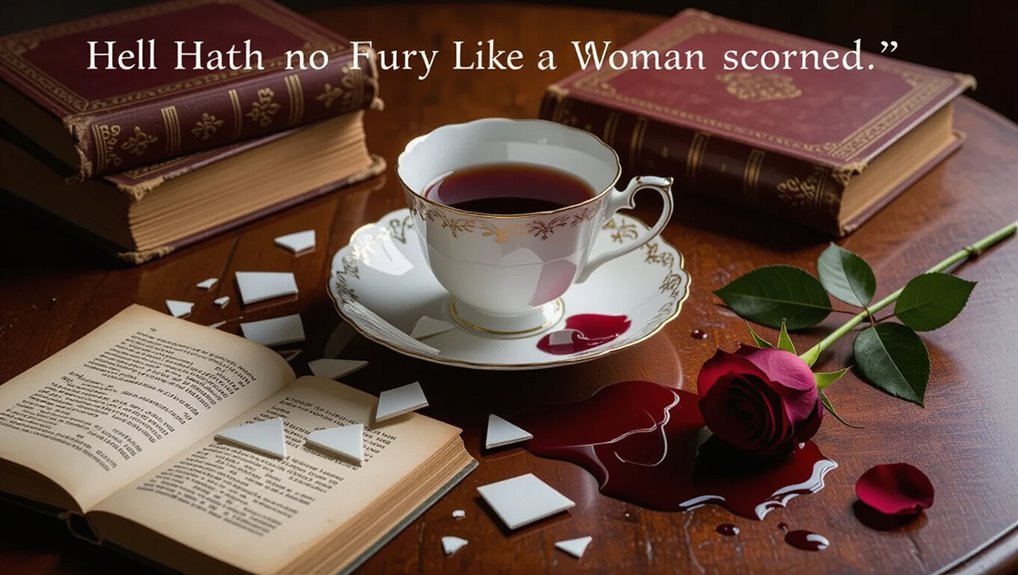
The phrase “hell hath no fury like a woman scorned” serves as a powerful reminder of the depth of anger that betrayal can ignite. Originating from William Congreve’s 1697 play, it highlights the fierce retaliation that can arise from deep emotional wounds.
Here are 20 unique reflections on this timeless sentiment:
- Betrayal ignites a fire that can consume even the strongest bonds.
- Wounded hearts can unleash storms more powerful than we imagine.
- Anger is a shadow cast by love once lost.
- Scorn transforms pain into a weapon of fierce determination.
- A woman wronged is a force of nature, unyielding and fierce.
- The sting of betrayal can awaken a dormant warrior within.
- Love’s betrayal can turn gentle spirits into tempestuous souls.
- Injustice can awaken a fierce protector, ready to retaliate.
- Scorn is the echo of love turned bitter and vengeful.
- The heart’s fury can be a relentless tide against betrayal.
- When love is betrayed, the aftermath is a battlefield.
- A woman scorned carries the weight of righteous fury.
- Pain can be a catalyst for empowerment and vengeance.
- Betrayal is a spark; the ensuing fire can be devastating.
- The heart’s wounds can forge an iron will.
- Scorned love can transform tenderness into unyielding strength.
- A woman’s wrath is often fueled by the ashes of trust.
- The fiercest battles are often fought within the heart.
- Anger born from love’s betrayal is a force to respect.
- Scorn isn’t merely anger; it’s the voice of hurt demanding justice.
Famous Variations of Hell Hath No Fury Like a Woman Scorned
The phrase “Hell hath no fury like a woman scorned” has inspired countless adaptations and variations across literature, media, and everyday conversations. Its powerful sentiment resonates, leading to creative twists that capture the fierce emotions of betrayal and revenge.
Here are 20 unique interpretations reflecting this enduring theme:
- “Beware the wrath of a woman betrayed.”
- “A woman’s scorn ignites a fire that never dies.”
- “Cross her once, and you’ll face the storm.”
- “Anger a woman, and you awaken her fury.”
- “A scorned woman is a force of nature.”
- “When her heart breaks, the world trembles.”
- “Disrespect her love, and you’ll regret it.”
- “Her silence hides a tempest brewing within.”
- “A woman scorned is a warrior ready for battle.”
- “Underestimate her pain, and you’ll know her rage.”
- “The power of a scorned woman is unmatched.”
- “Her love was a gift; betrayal is the curse.”
- “Woe to those who tread on her heart.”
- “Her fury is the echo of a love lost.”
- “A wounded heart becomes a vengeful spirit.”
- “Ignite her anger, and you’ll fuel her fire.”
- “A woman’s scorn is a tale retold in shadows.”
- “Her heartbreak is the birthplace of revenge.”
- “In her silence lies the storm of her wrath.”
- “A scorned woman’s resolve is unbreakable.”
Literary Sources Behind Hell Hath No Fury Like a Woman Scorned
The phrase “Hell hath no fury like a woman scorned” has deep literary roots, primarily traced back to the 18th century. Its origins in William Congreve’s 1697 play, *The Mourning Bride*, encapsulate a powerful sentiment that has echoed through literature, mythology, and drama.
Here are 20 unique interpretations and reflections on the theme of a woman’s wrath when wronged:
- “A heart betrayed ignites a flame that no rain can extinguish.”
- “The silence of a woman scorned is louder than a thousand storms.”
- “Her vengeance is a tempest, fierce and unyielding.”
- “Beneath her calm lies a fury that shakes the heavens.”
- “A slighted woman wields her pain as a weapon of fire.”
- “Injustice to a woman is like stirring a hornet’s nest.”
- “The wounds of betrayal forge the sharpest blades.”
- “Her tears can summon storms, her rage can split the earth.”
- “From ashes of love, a phoenix of wrath rises.”
- “The fury of a woman is a force of nature, untamed and wild.”
- “Her heart, once tender, becomes a well of unquenchable fire.”
- “To cross a woman’s heart is to dance with the devil.”
- “A woman scorned is a tempest in the making.”
- “Her grief transforms into a sword, striking with precision.”
- “The echoes of betrayal resonate louder in a woman’s soul.”
- “Love’s betrayal turns a gentle breeze into a raging gale.”
- “Her spirit, once nurturing, now roars like a lioness.”
- “The storm of her indignation knows no boundaries.”
- “Her love turned to ashes ignites a wildfire of vengeance.”
- “In the theater of life, her wrath takes center stage.”
How to Use Hell Hath No Fury Like a Woman Scorned in Writing
Introduction:
The phrase “Hell hath no fury like a woman scorned” serves as a powerful lens through which to explore complex emotions and relationships.
Employed thoughtfully, it can heighten tension, reveal character depth, and illuminate the consequences of betrayal.
By weaving this sentiment into your narrative, you can craft moments that resonate with authenticity and emotional weight.
Unique Quotes:
- “Her silence was more explosive than any scream, a smoldering volcano of unspoken rage.”
- “In her eyes, betrayal ignited a fierce fire, but it was her calm that chilled the room.”
- “With each choice she made, the echoes of his deceit carved deeper lines into her heart.”
- “Her laughter, once warm, now felt like shards of ice piercing through the air.”
- “He thought her tears were a sign of weakness, unaware they were the seeds of her strength.”
- “Every soft touch masked the tempest brewing beneath; she was a storm waiting to break.”
- “Her restraint was a weapon, sharper than any blade, cutting through the façade of love.”
- “In the quiet aftermath of betrayal, she found a resolve that burned brighter than anger.”
- “He underestimated the power of her silence; it was the calm before an inevitable storm.”
- “As she walked away, each step echoed with the weight of a thousand unspoken words.”
- “Beneath her poised exterior lay a heart that could shatter mountains with its fury.”
- “Every glance exchanged held the tension of a thousand unresolved conflicts.”
- “Her forgiveness wasn’t a weakness; it was a choice that would alter their destinies.”
- “The warmth of their shared memories felt like a ghost haunting her every moment.”
- “She knew the cost of love too well; it was a currency that had long since devalued.”
- “In the flicker of candlelight, her heart waged war against the shadows of the past.”
- “Each word spoken was a brushstroke on the canvas of their fractured trust.”
- “Her smile, once a sanctuary, now masked a battlefield where emotions clashed.”
- “With every calculated move, she turned the tables, redefining the game they played.”
- “In the stillness, she discovered a fierce clarity, her heart no longer a captive of his lies.”
Modern Interpretations of Hell Hath No Fury Like a Woman Scorned
The phrase “hell hath no fury like a woman scorned” has evolved, reflecting today’s complexities around betrayal and female empowerment. It captures a spectrum of emotions, blending anger with resilience, self-assertion, and humor.
Here are 20 unique interpretations that illustrate this modern perspective:
- “Her fury ignites a fire of transformation, turning betrayal into empowerment.”
- “In her anger, she finds her voice—a chorus of resilience echoing through silence.”
- “Scorned but not broken, she channels her pain into purpose.”
- “Her laughter, sharp as her resolve, dismantles the myths of feminine fury.”
- “She rises from the ashes of betrayal, a phoenix of self-reclamation.”
- “Anger is only the beginning; her journey leads to self-discovery.”
- “With each boundary set, she reclaims the narrative of her own life.”
- “Her wrath is a fierce protector of dignity, not mere vengeance.”
- “In solidarity, her anger becomes a rallying cry for change.”
- “She wears her scars like armor, each one a testament to her strength.”
- “Her fury isn’t chaos; it’s the orchestrated symphony of her story.”
- “With every exposé, she dismantles the silence that once confined her.”
- “In the face of betrayal, she chooses empowerment over despair.”
- “Her anger is a catalyst, igniting conversations that challenge stereotypes.”
- “She transforms her pain into a canvas, painting a future of agency.”
- “Behind her fury lies a fierce commitment to her own narrative.”
- “She laughs in the face of betrayal, wielding humor as her shield.”
- “Her scorn is a stepping stone, not a stumbling block, on her path.”
- “She rewrites the script of anger, infusing it with resilience and hope.”
- “In reclaiming her power, she turns the tide of her own story.”
Cultural Impact of Hell Hath No Fury Like a Woman Scorned
The phrase “hell hath no fury like a woman scorned” has permeated various cultural spheres, influencing how society perceives female anger. While it can empower women and validate their emotions, it also risks reducing complex feelings to mere stereotypes.
Recognizing its dual impact encourages a more nuanced understanding of female rage.
- “Anger is a powerful force; when wielded by a woman, it can reshape worlds.”
- “To scorn a woman is to awaken a tempest of untamed passion.”
- “Her fury isn’t chaos; it’s a clarion call for justice.”
- “In her wrath lies the strength of generations unspoken.”
- “A woman scorned transforms pain into a rallying cry.”
- “Her anger isn’t a flaw; it’s the fire of her resilience.”
- “When a woman stands up, the ground shakes beneath her fury.”
- “Rage can be a revolution; watch as she ignites the spark.”
- “In the depths of scorn, a woman finds her voice.”
- “Her fury is a canvas where stories of survival are painted.”
- “Scorn may burn brightly, but it also illuminates the path to empowerment.”
- “Behind a woman’s anger lies a tapestry of unacknowledged hurt.”
- “To dismiss her rage is to deny the power of her truth.”
- “Her emotions are a storm, but storms can clear the air.”
- “In her scorn, she unearths the strength to redefine her narrative.”
- “A woman’s fury can be a fierce protector of her dignity.”
- “The flames of her anger can forge new beginnings.”
- “When scorned, a woman’s heart becomes an unyielding fortress.”
- “Her rage is a testament to her unbreakable spirit.”
- “From the ashes of betrayal, a woman’s fury rises as a phoenix.”
Misconceptions About Hell Hath No Fury Like a Woman Scorned
The phrase “hell hath no fury like a woman scorned” is often misinterpreted, reducing women’s emotional responses to mere stereotypes. It’s important to challenge this notion and recognize the diverse ways individuals handle betrayal, moving beyond simplistic narratives.
- “Anger is a valid response, but it can manifest in many forms beyond vengeance.”
- “Not every woman’s pain is expressed through fury; some find strength in silence.”
- “Betrayal can spark growth as much as it can ignite rage.”
- “Context matters; a woman’s reaction is shaped by her unique story.”
- “Emotions are complex; don’t reduce them to a single narrative.”
- “Resilience can be a response just as powerful as anger.”
- “Women aren’t monoliths; their reactions are as varied as their experiences.”
- “Disappointment often leads to reflection rather than retaliation.”
- “Constructive dialogue can heal wounds more than fiery outbursts ever could.”
- “Expecting revenge limits the potential for understanding and resolution.”
- “Every individual has their own way of coping with betrayal, regardless of gender.”
- “Anger can be a mask; often, deeper feelings lie beneath.”
- “To assume rage is a woman’s default is to undermine her depth.”
- “Self-protection can take precedence over vengeance in many situations.”
- “Empathy should guide our understanding of emotional responses.”
- “Women can channel pain into creativity rather than conflict.”
- “True strength often lies in restraint and thoughtful response.”
- “Stereotypes diminish the complexity of human emotion.”
- “Not all storms are destructive; some can lead to clarity and calm.”
- “Recognizing diversity in reactions fosters more meaningful connections.”
Examples of Hell Hath No Fury Like a Woman Scorned in Media
The portrayal of scorned women in media presents a complex landscape, oscillating between vengeful stereotypes and nuanced characterizations. While traditional narratives often highlight retaliation, modern interpretations invite deeper exploration of emotions, motivations, and consequences. Let’s delve into unique perspectives on this theme.
- “In the ashes of betrayal, a woman’s strength often ignites.”
- “Revenge may satisfy, but healing transforms.”
- “Her fury is a storm, but the calm that follows is profound.”
- “Scorn can be a catalyst for empowerment, not just vengeance.”
- “Behind every fierce response lies a heart in turmoil.”
- “Resilience blooms even in the harshest of betrayals.”
- “To be scorned is to be reborn; each scar tells a story.”
- “Empathy can rewrite the narrative of revenge.”
- “A woman’s anger can be a powerful force for change.”
- “Retaliation is fleeting; self-discovery is eternal.”
- “In the depths of betrayal, she finds her voice.”
- “Vengeance might be tempting, but freedom lies in forgiveness.”
- “Her pain is palpable, yet her strength is undeniable.”
- “From betrayal rises a phoenix of resilience.”
- “A scorned woman crafts her own narrative, unbound by stereotypes.”
- “She may be hurt, but she refuses to be defined by it.”
- “Empowerment often hides behind the mask of anger.”
- “Revenge is a chapter; healing is the whole book.”
- “Her journey from scorn to strength is the real story.”
- “When scorned, she doesn’t just seek justice; she seeks herself.”
Historical Context of Hell Hath No Fury Like a Woman Scorned
The phrase “hell hath no fury like a woman scorned” encapsulates historical fears surrounding female anger and agency. Originating from William Congreve’s 1697 play, it reflects centuries of cultural attitudes toward gender, honor, and emotional retribution.
This powerful sentiment has influenced societal perceptions and narratives about women’s roles in expressing discontent and seeking justice.
- “A woman’s wrath is a tempest; it swirls and crashes, demanding acknowledgment.”
- “In the silence of betrayal, a woman discovers her voice.”
- “Anger can be an artist, painting a new narrative from the canvas of hurt.”
- “When scorned, a woman transforms her pain into a weapon of liberation.”
- “Behind every furious heart lies a story of injustice waiting to be told.”
- “The fury of a woman is a force of nature, uncontainable and fierce.”
- “To underestimate a woman’s pain is to invite her wrath.”
- “In the ashes of betrayal, a woman rises like a phoenix, unyielding.”
- “A scorned woman doesn’t seek revenge; she seeks recognition of her worth.”
- “Her anger isn’t chaos; it’s clarity forged in the fires of betrayal.”
- “When pushed to the edge, a woman’s fury becomes her greatest ally.”
- “A woman scorned is a symphony of emotions, each note a battle cry.”
- “In the depths of disappointment, a woman often finds her true strength.”
- “Her rage is a mirror reflecting the world’s injustices.”
- “To scorn a woman is to ignite a spark that can light the darkest nights.”
- “A woman’s fury is a storm, but also the promise of renewal.”
- “Beneath her anger lies a reservoir of untapped potential.”
- “Her retaliation isn’t merely vengeance; it’s a reclamation of her narrative.”
- “The power of a woman scorned is a reminder of her indomitable spirit.”
- “In her fury, she finds the courage to rewrite her story.”
Comparing Hell Hath No Fury Like a Woman Scorned to Similar Idioms
The concept of a woman’s wrath has resonated through time and cultures, reflected in various idioms and proverbs. These expressions reveal societal views on anger, honor, and the consequences of betrayal. Below are 20 unique quotes that capture the essence of this theme:
- “A heart bruised by betrayal knows no bounds in its fury.”
- “To anger a woman is to awaken a storm.”
- “Her silence speaks volumes, but her wrath is deafening.”
- “When honor is tarnished, vengeance becomes a woman’s armor.”
- “In the depths of pain, a woman’s strength is forged.”
- “A woman scorned is a force of nature, unrestrained and wild.”
- “Her anger is a fire; it can warm or consume.”
- “Behind her smile lies the tempest of unspoken fury.”
- “To underestimate her wrath is to invite chaos.”
- “A woman’s wounded pride ignites the fiercest flames.”
- “In the shadows of betrayal, her vengeance finds its light.”
- “A scorned woman is a symphony of emotions, each note sharp.”
- “Her rage is a river, swift and unstoppable.”
- “When pushed to the edge, her resolve becomes unbreakable.”
- “Her fury is rooted in love lost, a vine of sharp thorns.”
- “A woman’s scorn is a mirror reflecting society’s failings.”
- “Words may wound, but her retribution can scar.”
- “In her heart lies both a sanctuary and a battlefield.”
- “Her anger is both a cry for justice and a plea for understanding.”
- “To cross a woman is to dance with the fire of her spirit.”
Conclusion
You’ve explored fierce phrases and familiar fables, so you’ll leave linking language to lore. Let your learning linger: look for lyrical lines, leverage literary legacies, and liven longer lines with lively, lucid language. When you write, wield words wisely—warn, woo, or warn off—with wit and warmth. Remember: raw rage and righteous revenge are rarely righteous routes; resist rash reactions, reroute resentment, and reach for reasoned resolution.